Play-Based vs Academic Preschools: Which Supports Holistic Development Better?
Play-based or academic preschool? How each approach affects holistic development, what research and NEP 2020 suggest, and how parents can tell which approach a school really follows.
 Rahul Varun
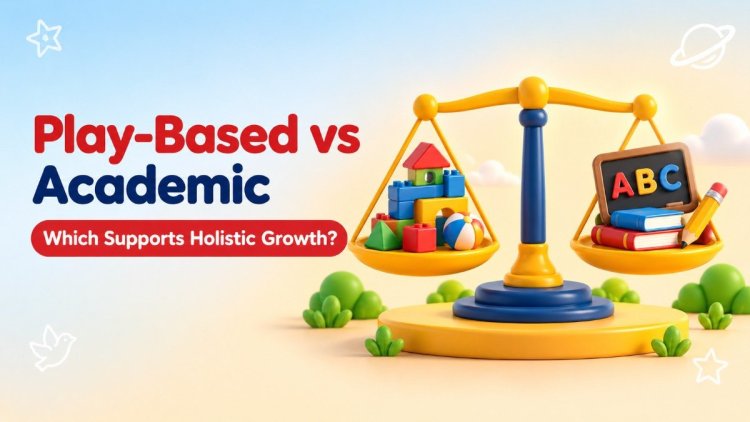
For children aged two to six, play-based preschools generally support holistic development better than heavily academic ones, because young children learn language, thinking, movement, social skills and emotional control most effectively through active play and conversation. India's NEP 2020 and the National Curriculum Framework for the Foundational Stage both favour play-based, activity-based learning for this age. That does not mean no structure. The best preschools combine planned play with gentle, age-appropriate early literacy and numeracy. This article explains the difference, what each approach looks like in a classroom, and how to tell which approach a school really follows.
What is the difference between play-based and academic preschools?
A play-based preschool teaches through guided play, activities and conversation, while an academic preschool focuses on early reading, writing and worksheets, often with more sitting and less movement.
In a play-based classroom, children might count fruits in a pretend shop, act out a story, build with blocks or explore sand and water. Teachers plan these activities carefully so that each one builds specific skills.
In a strongly academic classroom, children spend more time at desks, copying letters, completing worksheets and memorising. Parents may see more written work coming home, which can feel reassuring, but it often leaves less time for the activities that young children learn from most.
|
Aspect |
Play-based approach |
Academic approach |
|
How children learn |
Hands-on activities, games, stories, movement |
Worksheets, copying, repetition |
|
Daily routine |
Short varied blocks with free play and outdoor time |
Longer seated periods, less free play |
|
Early literacy |
Songs, stories, sounds, mark-making |
Letter formation and writing early |
|
Social and emotional skills |
Practised through group play and turn-taking |
Less built into the day |
|
What parents see |
Photos of activities, progress notes |
Notebooks and written work |
Why do experts favour play-based learning at this age?
Because play builds attention, language, problem-solving and self-control together, and these foundations support later reading, writing and maths.
Children under six learn by doing, talking and exploring. When a child builds a tower that falls, they learn about balance and also about frustration and trying again. When they play a role in a pretend game, they practise language and understanding of others.
NEP 2020 describes early education as flexible, multi-faceted, play-based and activity-based. The National Curriculum Framework for the Foundational Stage, released in 2022, builds on this. These frameworks do not reject early literacy and numeracy. They recommend introducing them through play, stories and hands-on activity.
Does play-based mean children learn less?
No. Well-planned play-based preschools still build early reading and maths skills, but they do it through activities that suit a young child's development.
A common worry is that children in play-based schools will fall behind. In practice, a good play-based preschool has clear learning goals for each age. Children learn letter sounds through songs, numbers through games, and early writing through drawing and fine-motor play.
The key difference is pace and method. Pushing formal writing too early can frustrate children whose hand muscles are not ready. Building those muscles through play first usually makes writing easier later.
What are the signs of a balanced preschool?
A balanced preschool has a planned daily routine, clear learning goals, plenty of play and movement, and age-appropriate early literacy and numeracy.
-
The timetable includes circle time, focused activity, free play, outdoor time and story time.
-
Teachers can explain what skill each activity builds.
-
Children move, talk and handle materials, rather than sitting for long periods.
-
Early literacy and numeracy appear through songs, stories and games.
-
Progress is shared through observation notes, not only through written work.
Many established preschool networks describe a blended approach. You can compare methods in this guide to Montessori, playway and Reggio Emilia approaches, and see how one network describes holistic development in its classrooms.
How can you tell which approach a school really follows?
Visit during class hours, look at what children are doing, ask to see the daily timetable and ask how progress is assessed.
Brochures often use the word "play-based". The classroom tells you the truth. Watch whether children are mostly active and engaged or mostly seated and copying. Ask what a typical day looks like for your child's age. Ask whether three-year-olds receive homework and how much.
Ask how the school shares progress. A school focused on holistic development will talk about language, social skills, movement and confidence, not only letters and numbers.
Which approach should you choose for your child?
For most children aged two to five, choose a balanced, play-based school with clear learning goals, and avoid schools that push heavy academics or homework at this age.
Every child is different, and families have different priorities. But for this age group, a school that combines play with gentle structure usually builds stronger foundations for later learning than one that focuses on early written work. Use the key factors to consider when choosing a preschool programme to compare your options.
Frequently asked questions
What is the best preschool for holistic development in India?
A preschool that blends planned play with age-appropriate learning goals, includes daily movement and outdoor time, and tracks social, emotional and physical growth as well as early academics.
Is a play-based preschool better than an academic one?
For children aged two to six, research and NEP 2020 favour play-based, activity-based learning, ideally with clear structure and goals.
Will my child be ready for Class 1 after a play-based preschool?
Yes, if the school has clear learning goals. Good play-based preschools build early literacy, numeracy and school readiness through activities.
Should three-year-olds get homework?
Most early years experts advise little or no formal homework at this age. Reading together and playful activities at home are more useful.
How do I know if a school is truly play-based?
Visit during class hours, watch what children are doing, review the daily timetable and ask how progress is assessed.
Author Bio
Written by an independent education-sector analyst who studies India's early-education franchise market, including brands such as EuroKids, Kidzee, Little Millennium and Shanti Juniors.