Reimagining Governance: The P4 Model and the Road to Inclusive Prosperity
 Influencive India
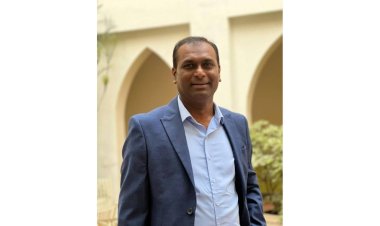
Cherukuri Kutumbarao
Vice-Chairman, Swarnandhra P4 Foundation,
Govt. Of Andhra Pradesh,
AMARAVATHI.
How visionary leadership and collaborative frameworks can transform poverty from a persistent challenge into a solvable mission

Dr. Sakhamuru Srinivasa Prasad,
Chief Editor, Repatikosam Telugu Daily
In the evolving discourse of governance, the difference between short-term political maneuvering and long-term societal transformation often defines the legacy of leadership. While many administrations prioritize immediate gains shaped by electoral cycles, a few stand apart by envisioning structural change that transcends generations. Among such leaders, N. Chandrababu Naidu has consistently demonstrated a commitment to forward-thinking governance, placing sustainable development above political expediency.
From his early initiatives like Vision 2020 to his more recent Vision 2047, Naidu’s approach reflects a deep understanding of the complexities of socio-economic progress. His governance philosophy is rooted in anticipating future challenges, leveraging technology, and building frameworks that empower citizens rather than making them dependent. It is within this broader vision that the P4 (Public-Private-People Partnership) model emerges as a transformative blueprint for addressing one of humanity’s oldest and most persistent challenges—poverty.
Moving Beyond Conventional Welfare
For decades, poverty alleviation strategies have largely revolved around welfare schemes and subsidies. While these initiatives provide temporary relief, they often fail to address the root causes of economic disparity. In many cases, they inadvertently foster dependency, limiting the scope for self-reliance and long-term growth.
The P4 model challenges this traditional paradigm. Instead of treating poverty as a condition to be managed, it approaches it as a systemic issue that can be eradicated through collective action. By bringing together the government, private sector, and citizens, the model creates a dynamic ecosystem where resources, opportunities, and responsibilities are shared.
This shift from a top-down welfare approach to a participatory development framework is what makes P4 particularly compelling. It recognizes that sustainable change cannot be achieved by governments alone—it requires the active involvement of all sections of society.
Understanding the Core of P4
At its essence, the P4 model is about bridging the gap between abundance and deprivation. In most societies, a small percentage of the population controls a significant portion of wealth, while a larger segment struggles with limited access to basic resources. This imbalance is not just an economic issue; it has social and developmental implications that hinder overall progress.
The P4 framework seeks to correct this imbalance by creating pathways for collaboration:
- Public (Government): Provides policy support, infrastructure, and institutional backing.
- Private (Businesses): Contributes investment, innovation, and efficiency.
- People (Citizens): Participate actively in their own development and support community-driven initiatives.
What sets this model apart is the emphasis on human connection. It is not merely about financial redistribution but about creating relationships that foster trust, mentorship, and opportunity.
A Vision Rooted in Participation
One of the defining features of Naidu’s governance style is his belief in the power of participation. He has consistently emphasized that policies are only as effective as the level of public engagement they inspire. The P4 initiative embodies this principle by encouraging citizens to become stakeholders in the development process.
In practical terms, this could mean affluent individuals or organizations supporting underprivileged families through skill development, education, or employment opportunities. It could also involve communities working together to create local solutions tailored to their unique challenges.
Such an approach not only accelerates economic upliftment but also strengthens social cohesion. When people actively contribute to each other’s progress, it fosters a sense of shared responsibility and collective growth.
Tackling Poverty at Its Roots
Poverty is not a monolithic issue; it is a complex interplay of factors including lack of education, limited access to healthcare, unemployment, and social inequality. Addressing it requires a multi-dimensional strategy that goes beyond financial aid.
The P4 model addresses these underlying factors by focusing on empowerment rather than assistance. By facilitating access to skills, resources, and opportunities, it enables individuals to break free from the cycle of poverty. This approach aligns with the idea that true development is not about giving people what they need to survive, but equipping them with the tools to thrive.
Moreover, by involving the private sector, the model introduces efficiency and innovation into the process. Businesses bring expertise, scalability, and a results-oriented mindset, which enhances the effectiveness of development initiatives.
A Global Perspective
Although pioneered in Andhra Pradesh, the principles underlying the P4 model have universal relevance. Poverty exists across the world, cutting across geographical, cultural, and economic boundaries. From developing nations to advanced economies, disparities in wealth and opportunity remain a significant challenge.
What makes P4 particularly noteworthy is its adaptability. The framework can be customized to suit different socio-economic contexts, making it a potential model for global replication. Its emphasis on collaboration and participation resonates with contemporary development theories that advocate inclusive growth.
Beyond Politics: A Moral Imperative
One of the most striking aspects of the P4 initiative is its limited political appeal in the traditional sense. Unlike populist schemes that promise immediate benefits, P4 focuses on long-term outcomes that may not translate into instant electoral gains. By promoting self-reliance, it reduces dependency on government support, which is often a cornerstone of vote-bank politics.
This makes the initiative not just a policy decision, but a moral stance. It reflects a commitment to genuine societal transformation rather than short-term political advantage. In doing so, it challenges the conventional wisdom of governance and sets a new benchmark for leadership.
Building a Future Without Poverty
The vision of a poverty-free society is ambitious, but not unattainable. It requires a shift in mindset—from viewing poverty as an inevitable reality to recognizing it as a solvable problem. The P4 model provides a roadmap for this transformation by combining vision, strategy, and collaboration.
By narrowing the gap between the privileged and the underprivileged, it creates a more balanced and equitable society. More importantly, it restores dignity to individuals by enabling them to participate actively in their own development.
Conclusion
In a world where governance is often constrained by short-term thinking, the P4 model stands out as a beacon of long-term vision and inclusive growth. Through his innovative approach, N. Chandrababu Naidu has demonstrated that meaningful change is possible when leadership is guided by purpose rather than politics.
The journey toward a poverty-free society is undoubtedly complex, but frameworks like P4 show that with the right combination of policy, participation, and perseverance, it is a goal within reach. As societies continue to grapple with inequality and economic disparity, such models offer not just solutions, but hope for a more just and prosperous future.